
As someone who moved to Australia lately, the recent bushfires has been a new awakening and a grim encounter with the realities of climate change - Sydney drenched in thick smoke was a glimpse of apocalyptic events. Dense forests fraught with years of drought have turned vast swathes of land to chunks of inflammable fuel, awaiting a benign spark to rage itself. We saw this happen in the Amazon, Siberia and now in Australia, and we might see worse in the coming years at unforeseen locations.
We should definitely be addressing climate change, global warming and evolve measures to offset the effects and mend our ways to try and reverse the adverse effects of global warming, which to some extent has been a creation of our own through unfettered consumerism. The efforts to heal might take years or even decades to deliver and tangible results to manifest.
From a crisis management point of view, we need to address the fact that climate change is real and atmosphere is getting warmer than ever before. There is extraordinary decline in polar ice caps and evaporation of water is at its peak, resulting in devastating rains and floods. Crops are being destroyed at an unprecedented scale taking a toll on the livelihoods of millions. Inundations have devastated lives of people, driven up insurance costs, medical emergencies have been unable to cope with resulting calamities and large scale climate migrations have become a reality. People and infrastructure including farmlands are being displaced and destroyed, dreams shattered and hopes lost for an entire generation. Warmer temperatures in otherwise cold places are creating a whole lot of new problems - menace of pests and the advent of otherwise unheard epidemics are just a few. The economic costs are huge - traditional sectors like the fishing industry facing death knell due to mass migration of sea life to cooler waters, the losses of which would run into billions.
An honest acknowledgment of the current crisis would certainly help us in taking on the biggest existential threat facing humanity. It is human nature to confront and tackle issues when revealed in full. Unfortunately, this time around, we cannot afford to wait for the apocalyptic unravelling of our planet - once past the tipping point, we would be at a point of no return. Going green, reducing dependency on fossil fuels and holding ourselves responsible for our own carbon footprint can go a long way in achieving sustainable living and prolonging life on this planet.
Anticipation is the key and the acknowledgement that years of drought have transformed lush green vegetation into fuel would be the first step in tackling the bush fire crisis that has gripped Australia. A tree sapped off its water is akin to a firewood awaiting to unleash hellfire - once the gravity of this risk is acknowledged we can take adequate steps and ensure such an eventuality is contained and to some extent prevented. Unlike the traditional form of fuel, it is practically impossible to insulate millions of water sapped vegetation simply because of its sheer size and the costs involved - forest strips run into thousands of kilometers.
Offsetting is not always viable and we have to accept a certain amount of risk to help us prepare better. Acknowledging the fact that forest fire is a real possibility in hot conditions would be a major first step in helping us divert our attention to devise ways on how to contain it, and even prevent such massive destruction from occurring.
Creating "Firebreaks" in high risk areas and prescribed burning (controlled burning) outside of the fire season could prove very effective if combined with modern science and technology - better mapping techniques and coordination of resources would certainly help employ such measures on a grand scale.
Anticipating what could go wrong in adverse conditions is critical, but at the same time, adopting indigenous aborigine tribes' ritualistic practices like the ancient prescribed burning of landscapes can go a long way in reducing the extent of destruction as witnessed recently. Respecting indigenous knowledge is as important as adhering to any modern empirical study, a tribe that has sustained itself on this land for millennia, respecting and adoring nature and its ecosystem. As an intelligent species we owe a huge responsibility to millions of our co-inhabitants residing in the earth's forests. Let us work towards making the future brighter for everyone, and if that means scaling back on some of our comforts, then let's not hesitate.
- Vinod Geeachan
References:
https://www.theguardian.com/commentisfree/2020/jan/11/how-first-australians-ancient-knowledge-can-help-us-survive-the-bushfires-of-the-future
https://climate.nasa.gov/news/2940/greenlands-rapid-melt-will-mean-more-flooding/
https://www.kkl-jnf.org/forestry-and-ecology/fire-prevention/forest-maintenance.aspx
We should definitely be addressing climate change, global warming and evolve measures to offset the effects and mend our ways to try and reverse the adverse effects of global warming, which to some extent has been a creation of our own through unfettered consumerism. The efforts to heal might take years or even decades to deliver and tangible results to manifest.
 |
| © NASA |
An honest acknowledgment of the current crisis would certainly help us in taking on the biggest existential threat facing humanity. It is human nature to confront and tackle issues when revealed in full. Unfortunately, this time around, we cannot afford to wait for the apocalyptic unravelling of our planet - once past the tipping point, we would be at a point of no return. Going green, reducing dependency on fossil fuels and holding ourselves responsible for our own carbon footprint can go a long way in achieving sustainable living and prolonging life on this planet.
Anticipation is the key and the acknowledgement that years of drought have transformed lush green vegetation into fuel would be the first step in tackling the bush fire crisis that has gripped Australia. A tree sapped off its water is akin to a firewood awaiting to unleash hellfire - once the gravity of this risk is acknowledged we can take adequate steps and ensure such an eventuality is contained and to some extent prevented. Unlike the traditional form of fuel, it is practically impossible to insulate millions of water sapped vegetation simply because of its sheer size and the costs involved - forest strips run into thousands of kilometers.
Offsetting is not always viable and we have to accept a certain amount of risk to help us prepare better. Acknowledging the fact that forest fire is a real possibility in hot conditions would be a major first step in helping us divert our attention to devise ways on how to contain it, and even prevent such massive destruction from occurring.
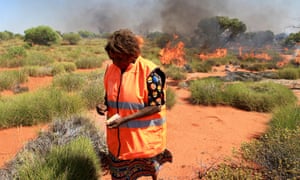 |
| Prescribed burning in Australia © The Guardian |
Creating "Firebreaks" in high risk areas and prescribed burning (controlled burning) outside of the fire season could prove very effective if combined with modern science and technology - better mapping techniques and coordination of resources would certainly help employ such measures on a grand scale.
Anticipating what could go wrong in adverse conditions is critical, but at the same time, adopting indigenous aborigine tribes' ritualistic practices like the ancient prescribed burning of landscapes can go a long way in reducing the extent of destruction as witnessed recently. Respecting indigenous knowledge is as important as adhering to any modern empirical study, a tribe that has sustained itself on this land for millennia, respecting and adoring nature and its ecosystem. As an intelligent species we owe a huge responsibility to millions of our co-inhabitants residing in the earth's forests. Let us work towards making the future brighter for everyone, and if that means scaling back on some of our comforts, then let's not hesitate.
- Vinod Geeachan
References:
https://www.theguardian.com/commentisfree/2020/jan/11/how-first-australians-ancient-knowledge-can-help-us-survive-the-bushfires-of-the-future
https://climate.nasa.gov/news/2940/greenlands-rapid-melt-will-mean-more-flooding/
https://www.kkl-jnf.org/forestry-and-ecology/fire-prevention/forest-maintenance.aspx


